
Unlock more guides and resources
Why Proper Equipment Matters
Equipment selection should follow the written scope, affected materials, dust and chemical hazards, containment plan, worker-protection requirements, and drying goal. Poor selection or use can contribute to:
- Cross-contamination of clean areas during remediation
- Incomplete removal that allows mold to return
- Health risks to workers and occupants
- Failed post-remediation verification
- Additional costs to redo the work properly
Air Filtration Equipment
Disturbing moldy material can release particles. Local capture, containment, careful work methods, and appropriately configured filtration may reduce their movement, but an air machine does not remove contamination from materials.
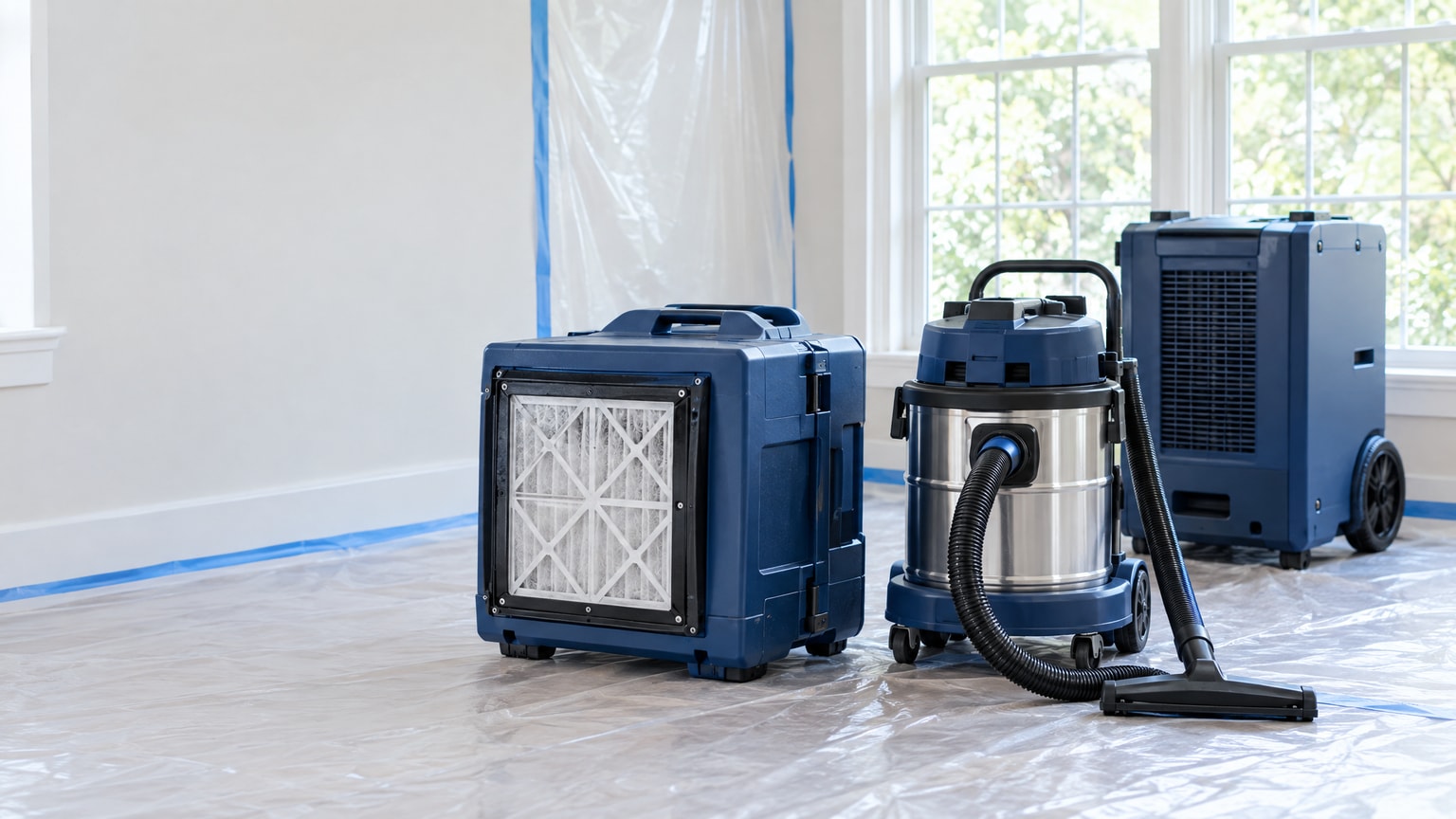
Air Scrubbers / Negative Air Machines
These are the workhorses of mold remediation. They serve two purposes:
- Support negative pressure when the containment design requires it
- Filter airborne spores and particles from the work area
- Recirculate or exhaust filtered air as the project plan and equipment instructions allow
Key checks: Verify HEPA performance, airflow under filter loading, safe exhaust location, electrical requirements, pressure monitoring, and the airflow target specified in the containment plan.
HEPA Air Purifiers
Portable HEPA air purifiers are used for:
- Supplemental particle reduction in occupied areas
- Project-specific use during final cleaning
- Temporary filtration while source correction is underway
Note: A portable air cleaner does not replace source removal, containment, surface cleaning, or drying and cannot prove that a room is safe.
HEPA Filters: Understanding the Standard
Under the OSHA definition, a HEPA filter is at least 99.97 percent efficient at removing monodisperse particles 0.3 micrometers in diameter. Treat that as a performance specification, not a claim that the installed machine captures every particle in a real project.
- Confirm the machine and filter are designed to work together
- Check seals, housing condition, prefilters, and pressure or service indicators
- Do not assume “HEPA-type” or “HEPA-like” is a HEPA performance claim
- Inspect and replace filters according to the manufacturer and project plan
Containment Materials
Proper containment isolates the work area to reduce movement of dust and debris into other areas. Learn more about containment and negative air pressure.
Barrier Materials
- Polyethylene sheeting (6-mil thickness minimum)
- Reinforced poly for high-traffic areas or reuse
- Fire-retardant poly where required by code
- Zipper doors for entry/exit points
- Spray adhesive and poly tape for sealing seams
Support Equipment
- Telescoping poles for floor-to-ceiling barriers
- Spring clamps and magnetic holders
- Duct tape and foil tape for sealing HVAC
- Plastic covers for furniture and fixtures
- Warning signs and barrier tape
Personal Protective Equipment (PPE)
CDC recommends at least a NIOSH Approved N95 respirator, gloves, and eye protection for mold cleanup. Additional protection depends on the task, duration, contaminants, and hazards; project area alone is not a complete PPE assessment.
Respiratory Protection
- Use a NIOSH Approved respirator selected for the task and hazards
- Use the correct model, size, filter or cartridge, and service-life plan
- Perform a user seal check each time a tight-fitting respirator is put on
- Keep facial hair and other items from crossing the sealing surface or interfering with valves
For employees, OSHA requires an employer respiratory-protection program when respirators are required, including hazard-based selection, medical evaluation before required use, fit testing before use and at least annually for tight-fitting respirators, training, maintenance, and records.
Body Protection
- Disposable coveralls (Tyvek or equivalent)
- Disposable shoe covers or dedicated work boots
- Head covering or hood
- Task-appropriate clothing that can be removed without spreading debris
Follow the project's entry, decontamination, removal, disposal, and laundering procedure.
Hand and Eye Protection
- Gloves selected for the material, cleaner, and cut or puncture hazards
- Goggles without ventilation holes for EPA minimum cleanup guidance
- Face shield for overhead work
- Hearing protection if using loud equipment
Match PPE and Expertise to the Hazard
- 1
Small, ordinary hard-surface cleanup
Use at least a NIOSH Approved N95 respirator, protective gloves, goggles without ventilation holes, and clothing that covers exposed skin. Follow product labels and respirator instructions.
- 2
More disturbance, duration, or contamination
Do not select a respirator from area alone. An experienced professional should assess particles, cleaning chemicals, sewage or flood contamination, confined spaces, heat stress, and other hazards.
- 3
Occupational work
Employers must evaluate hazards and comply with applicable OSHA PPE and respiratory-protection requirements, including medical evaluation and fit testing when required.
Moisture Detection Tools
Finding and fixing moisture sources is essential for successful remediation. Mold returns if moisture problems persist.
Moisture Meters
Two main types:
- Pin-type meters: Measure moisture content in wood and drywall by electrical resistance. Accurate but leave small holes.
- Pinless meters: Non-invasive scanning for moisture behind surfaces. Good for screening but less precise.
- Combination meters: Offer both modes for comprehensive assessment.
Interpretation: Compare readings with the material, meter mode, local conditions, project dry standard, and unaffected reference material. A universal percentage does not apply to every wood product or building material.
Thermal Imaging Cameras
Infrared cameras show surface-temperature patterns that may help target further moisture investigation:
- Screen for patterns consistent with evaporation or thermal bridging
- Help trace an area for follow-up with direct measurements
- Track temperature patterns during drying
- Document conditions before and after work
A thermal image does not detect water or mold by itself. Confirm suspected moisture with an appropriate meter, inspection, or other direct evidence.
Other Detection Equipment
- Hygrometers: Measure relative humidity (keep below 50%)
- Thermo-hygrometers: Combined temperature and humidity measurement
- Borescopes: Inspect inside wall cavities through small holes
- Psychrometers: Calculate dew point to identify condensation risk
Cleaning Equipment
Proper cleaning equipment removes mold contamination without spreading it.
HEPA Vacuums
Essential for capturing mold spores and debris:
- Must have true HEPA filtration (not HEPA-type)
- Used before, during, and after material removal
- Used on appropriate surfaces and cavities under the project plan
- Operated and emptied without releasing collected debris
Note: A vacuum without a sealed, verified high-efficiency filtration path may exhaust fine particles back into the space.
Cleaning Supplies
- Stiff bristle brushes and wire brushes for wood
- HEPA-rated sanding equipment for wood surfaces
- Microfiber cloths (disposable or launderable)
- Pump sprayers for cleaning solutions
- Buckets and mops for floor cleaning
- Detergent and water for appropriate hard surfaces
- EPA-registered products only when the label and project purpose support their use
DIY vs. Professional Equipment
Understanding the difference between consumer and professional equipment helps you know when a project exceeds DIY capabilities.
Consumer/DIY Equipment
- NIOSH Approved N95 respirators in the correct model and size
- Basic HEPA air purifiers (for supplemental cleaning)
- Material-appropriate moisture meters
- Consumer HEPA vacuums (limited suction)
- Basic hygrometers
- Standard cleaning supplies
Possible use: An uncomplicated area smaller than about 10 square feet may be handled by the occupant in most cases under EPA guidance. Hidden damage, sewage or floodwater, HVAC involvement, hazardous materials, or occupant risk can change that decision.
Professional Equipment
- Commercial air scrubbers (500-2000 CFM)
- Professional HEPA vacuums with attachments
- Thermal imaging cameras
- Professional moisture meters and psychrometers
- Containment systems and negative air setups
- PAPRs and full-face respirators
- Dehumidifiers (commercial capacity)
Professional judgment: More extensive, hidden, HVAC, contaminated-water, or structural work may require experienced professionals, stronger controls, and different equipment.
When to Call a Professional
Choose professional help based on the hazards, scope, access, and controls the work requires—not simply whether equipment is available to rent. Consider an experienced remediator when:
- Containment and negative air pressure are needed
- Hidden moisture or inaccessible cavities require investigation beyond your training or safe access
- Commercial air scrubbing capacity is necessary
- Respiratory protection beyond voluntary N95 use is needed
- The project involves HVAC system contamination
Use our DIY vs. Pro quiz to help determine if your project needs professional equipment and expertise.
Equipment Rental Options
Equipment availability does not make a medium project suitable for DIY. Renting a machine does not replace hazard assessment, containment design, respiratory-protection compliance, training, or a written remediation plan.
Commonly Available Rentals
- HEPA-filtered air scrubbers or negative-air machines
- Commercial dehumidifiers
- HEPA-filtered vacuums
- Moisture meters
- Air movers and containment equipment
Get a current local quote that includes filters, accessories, cleaning fees, delivery, electrical requirements, rental duration, and damage terms.
Rental Considerations
Renting equipment doesn't provide the expertise to use it correctly. Consider professional consultation even for DIY projects.
Where to Find Rental Equipment
- Home improvement stores (Home Depot, Lowes) - basic equipment
- Equipment rental centers (Sunbelt, United Rentals) - commercial grade
- Restoration equipment suppliers - specialized mold equipment
- Disaster restoration companies - may rent equipment between jobs