
Unlock more guides and resources
Quick Answer
Start by identifying and correcting the water or humidity source and drying affected materials. A dehumidifier can help when measured indoor relative humidity remains high. An air cleaner is optional only when you have a defined particle-control objective: non-ozone HEPA filtration may reduce some airborne particles when the unit is correctly sized, but it does not solve mold, reach settled or hidden growth, establish medical safety, or replace source control and remediation.
EPA recommends keeping indoor relative humidity below 60 percent, ideally 30 to 50 percent when possible. See our guide to humidity control and remember that an air-cleaner health benefit may vary by person and setting.
What a Dehumidifier Does
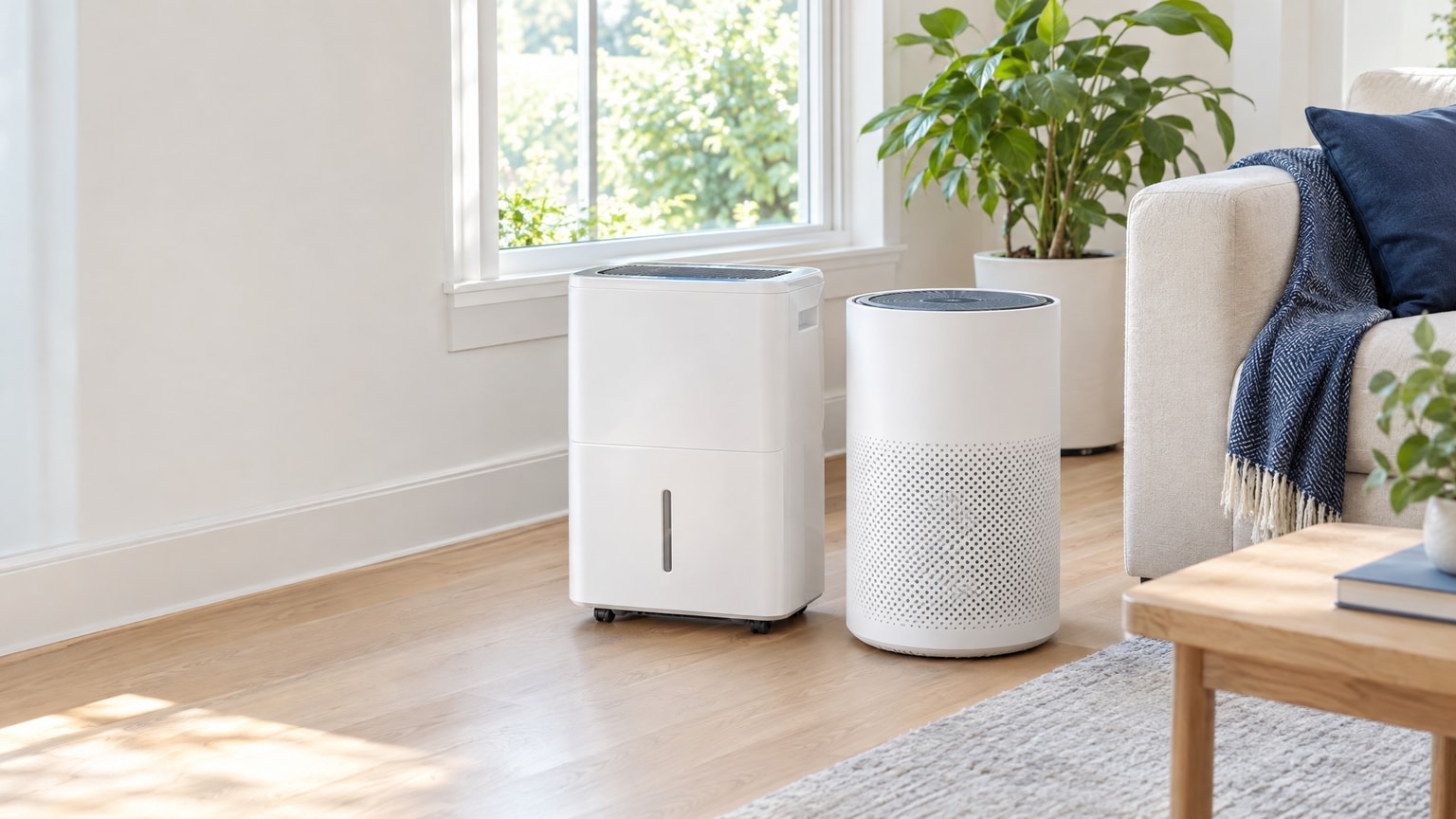
Dehumidifiers remove some moisture from air; they do not dry hidden wet assemblies or remediate mold. Use a hygrometer and correct leaks, drainage, ventilation, or other moisture sources first. A unit's capacity, operating range, and drainage setup depend on the model, space, and climate.
- Can reduce airborne moisture that supports mold growth when the unit is suitable for the space
- May help when measured humidity stays high after source-control steps
- Does not clean contaminated surfaces, dry every hidden cavity, or replace remediation
What an Air Purifier Does
EPA explains that portable air cleaners can reduce some airborne particles when properly selected, sized, and maintained. A non-ozone HEPA unit is an optional supplement for a defined particle-control objective; it does not solve the moisture source, reach settled or hidden growth, establish medical safety, or replace remediation. Any health benefit may vary by person and setting.
- Can reduce some airborne particles that pass through the filter
- Use only as an optional, correctly sized supplement for a defined particle-control objective
- Does not address moisture, settled or hidden growth, source control, or remediation
- Does not establish that an indoor space is medically safe
Learn more about airborne mold and how to interpret indoor results.
Which One You Need
Choose a Dehumidifier
- Measured indoor humidity remains high after leaks and other moisture sources are addressed
- The space or materials need air-moisture control while the source is being investigated
- The model capacity, operating range, drainage, and electrical requirements fit the space
Choose an Air Purifier
- You have a defined airborne-particle objective separate from moisture control
- You can select a non-ozone HEPA unit with CADR appropriate for the room volume
- You understand filtration is an optional supplement, not mold cleanup or medical-safety proof
- A project-specific containment and airflow plan calls for it during remediation
When Both May Be Appropriate
These are separate tools, not a default package. Consider both only when measured moisture remains high enough to justify humidity control and a separate, defined particle-control objective justifies optional filtration. Neither tool replaces fixing leaks, drying affected materials, or completing remediation.
During remediation, use an air cleaner only when the project-specific containment and airflow plan calls for it. See our guide on what to do after a leak for source-control and drying steps.
Sizing and Placement
- Dehumidifier capacity: Use the manufacturer's capacity and operating-range information for the room or space, climate, starting humidity, and drainage plan; follow the product's electrical and clearance instructions
- Air-cleaner CADR: Match the documented clean air delivery rate and room-size rating to the room volume and intended particle objective; for an open floor plan, account for the connected volume or use more than one unit
- Placement: Keep intakes and outlets clear and follow manufacturer clearances. Do not position equipment so it bypasses containment or moves air from an active work area unless the project plan specifies it
- Filter maintenance: Use the correct replacement filter and inspect, clean, or replace it on the product indicator or manufacturer instructions; a loaded filter reduces airflow
- Emission features: Choose non-ozone HEPA filtration. Avoid ozone generators, and avoid or disable ionizer, plasma, or other ozone-producing features unless a qualified project plan specifically addresses them